Defining Network Architecture
Network architecture is the logical and structural layout of the network, consisting of transmission equipment, software and communication protocols, and infrastructure (i.e. wired or wireless) transmission of data and connectivity between components.
The two types of widely used network architectures are peer-to-peer aka P2P and client/server aka tiered.
Peer-to-Peer Architecture
In a peer-to-peer network, tasks are allocated to every device on the network. Furthermore, there is no real hierarchy in this network, all computers are considered equal and all have the same abilities to use the resources available on this network. Instead of having a central server which would act as the shared drive, each computer thats connected to this network would act as the server for the files stored on it.
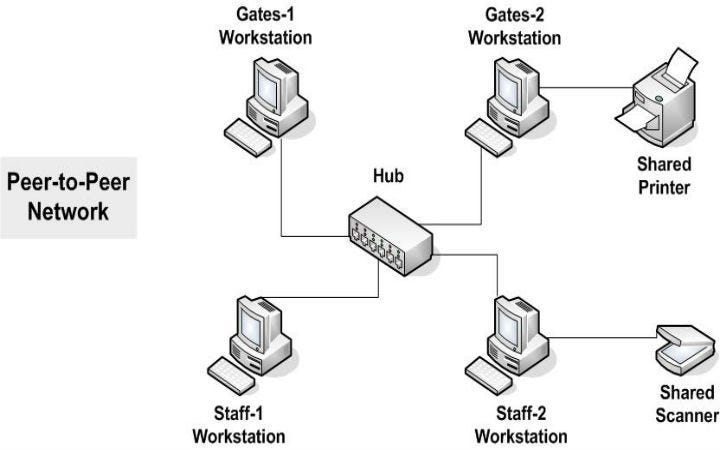
Advantages of a peer-to-peer network
- Does not require a dedicated server which means its less costly.
- If one computer stops working, the other computers connected to the network will continue working.
- Installation and setup is quite painless because of the built-in support in modern operating systems.
Disadvantages of a peer-to-peer network
- Security and data backups are to be done to each individual computer.
- As the numbers of computers increases on a P2P network… performance, security, and access becomes a major headache.
Client/Server Architecture
Client-server architecture, architecture of a computer network in which many clients (remote processors) request and receive service from a centralized server (host computer). In a client/server network, a centralized, really powerful computer(server) acts as a hub in which other computers or workstations(clients) can connect to. This server is the heart of the system, which manages and provides resources to any client that requests them.

Advantages of a client/server network
- Resources and data security are controlled through the server.
- Not restricted to a small number of computers.
- Server can be accessed anywhere and across multiple platforms.
Disadvantages of a client/server network
- Can become very costly due to the need of a server as well as networking devices such as hubs, routers, and switches.
- If and when the server goes down, the entire network will be affected.
- Technical staff needed to maintain and ensure network functions efficiently.
See more on: